
Skip to content
All productions
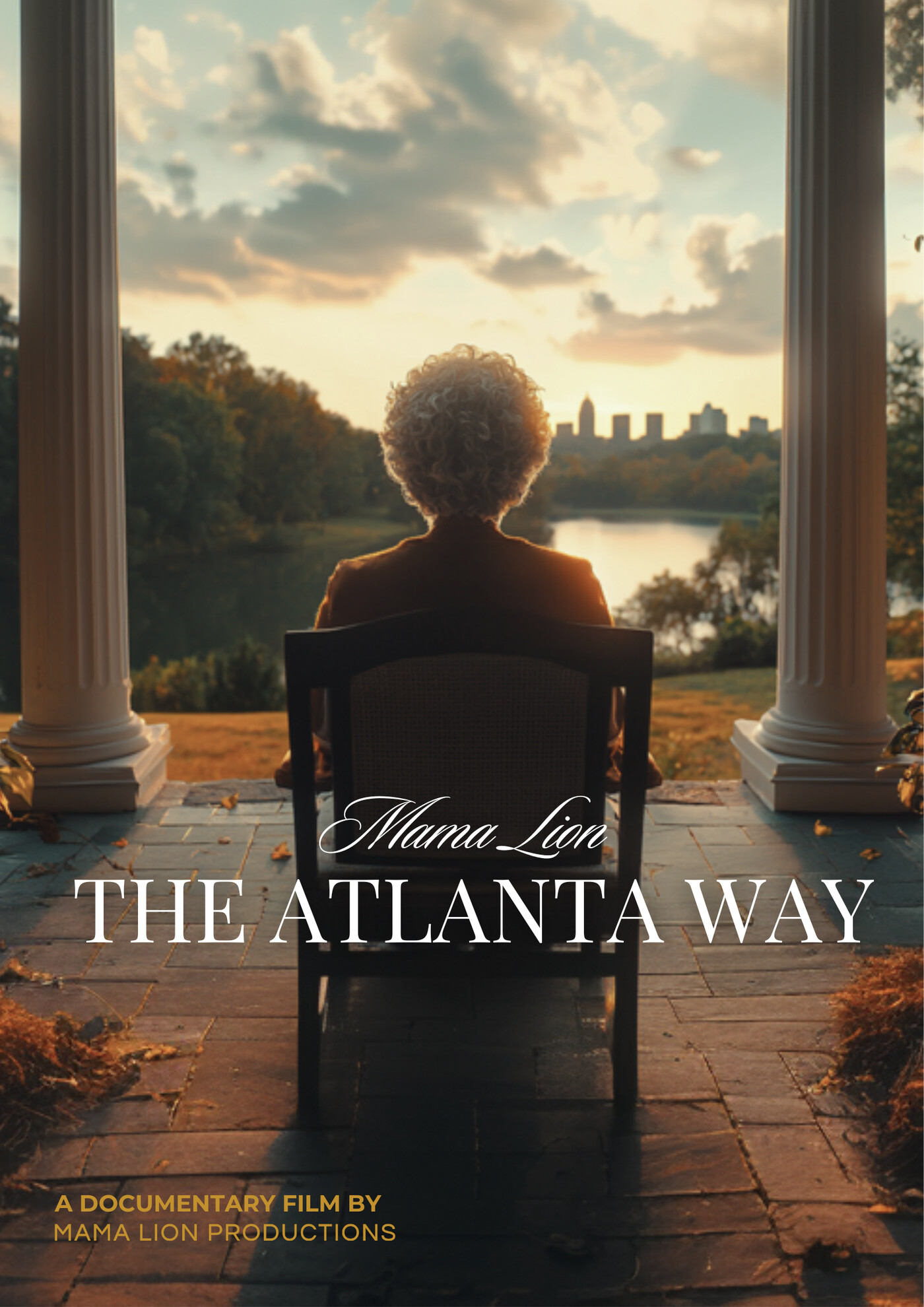
Mama Lion, The Atlanta Way poster: a woman seated between two white columns looking out over a lake toward the Atlanta skyline at sunset

Documentary feature

Mama Lion. The Atlanta Way

A documentary film by Mama Lion Productions

A family’s defiance against a segregated South ignites a legacy of rebellion. As Bettijo Cook Trawick fights to preserve the soul of Atlanta, she uncovers the raw power of heritage, justice, and the unrelenting quest for peace in a city torn between past and future.

The gala proposal refers to this documentary as Bettijo: The Atlanta Way. The connection is preserved here without asserting a rename, and no separate production record has been created for that wording.

Overview

What the film follows

The documentary follows the Cook family across generations, and places Bettijo Cook Trawick at its centre: a woman who resisted segregation and injustice in a city that was deciding what it wanted to be.

Its subjects are desegregation and the civil rights era, urban renewal and the fights it set off, and historical preservation as a form of civic argument rather than nostalgia.

Running underneath all of it is Atlanta’s balance between progress and tradition, and the question the film keeps returning to: what a city owes to the past while it builds the future.

The deck frames this as an intergenerational story. It records the risks the family took, the pursuit of justice and of peace, and the relationship between Atlanta’s transformation and Southern identity itself.

Descriptions on this page are the documentary's own account and framing. They are not offered as independent historical claims.

What the Atlanta Way means

Unity built out of unlikely alliances

The deck explains the phrase as unity built through unlikely alliances, and gives its own examples: conservative Republicans supporting social justice, progressive liberals finding common ground in church, Black civil rights leaders working alongside white senators, and communities honouring presidents, artists, civil rights figures and indigenous leaders together.

The emphasis throughout is on collaboration and on political discourse that stays in the room, which the deck treats as the city’s working method rather than as a slogan.

Tone

The documentary is reflective and celebratory. Its through line is Bettijo’s legacy continuing through her son Rodney, and it holds both halves of that: her pioneering contribution, and his ongoing commitment to civil rights and to preservation.

People and perspectives

Four lives, one argument

Bettijo Cook Trawick

Intellect, compassion and strategic activism

The deck describes a woman who combined intellect with compassion and worked strategically rather than loudly. She challenged social norms where they needed challenging, pressed for racial equality, and treated historic preservation as part of the same fight. Empathy, foresight and courage are the qualities the deck returns to.

Rodney Mims Cook (Rodney Cook Sr.)

Political advocacy and the prevention of deeper unrest

His part of the story is political advocacy: the work of preventing deeper unrest in a city where it would have been easy to let things break. The deck records his commitment to justice, his recognition of cultural symbols of division and what they do to a place, and the partnership between his systemic work and Bettijo’s cultural advocacy. He is a distinct person from Rodney Mims Cook Jr.

Rodney Mims Cook Jr.

Stewardship of his mother’s legacy

The deck follows him as the steward of his mother’s legacy, connecting historical activism to contemporary work through monuments, peace initiatives and public spaces, and extending her influence to generations that never met her.

Local civil rights leaders

The view from alongside

The deck sets out the perspectives of local civil rights leaders on the Cooks’ public and behind the scenes influence: the access they had, the risks they took, their opposition to segregation, and their contribution to peace and to the Atlanta Way.

The deck does not name individual interviewees, and no interview is presented here as completed.

Themes

All six, explained

01

Legacy and Influence

How Bettijo shaped the values her family worked from, and how those values became Rodney Jr.’s commitments rather than simply his inheritance.

02

Civil Rights and Social Justice

The line from the early struggle against segregation through to later activism, treated as one continuous effort rather than as separate eras.

03

Urban Preservation

Landmarks handled as part of social change. What a city chooses to keep standing is part of the argument it is having with itself.

04

Civic Responsibility

Community, peace and progress as obligations that fall on the people who can carry them, which is the deck’s reading of how the family acted.

05

Cultural Diplomacy

Preservation as a bridge between cultures, and as a way of speaking to people who would not have sat down together otherwise.

06

Resilience in the Face of Adversity

The mission continuing across generations, through opposition, loss and changes of era.

Archival and visual material

The archive the film is built from

The deck carries archival and contemporary galleries, including pages given over entirely to image collages. The captions, dates and credits supplied with that material are preserved with it.

Captioned material

  • A 1972 child care proposal.
  • A civil rights march at the Georgia State Capitol, May 17, 1960.
  • An election gathering, November 8, 1972.

Credit: Atlanta Journal-Constitution / Georgia State University, as supplied with the archival material.

Also in the galleries

  • The Smith Family Farm marker
  • Peace event and theatre imagery
  • Monuments and public spaces
  • International architectural references
  • Newspaper and campaign imagery
  • Family and civic photographs
  • Preservation imagery

Captions are kept as supplied. People are not identified by guessing from faces, and uncaptioned photographs are not given invented locations.

Historical racist intimidation imagery belongs to the documentary’s educational context. It is not used as decoration or as branding.

The archival images themselves are held in the documentary deck. They are not reproduced on this page yet, and will be published with their captions and credits intact once the deck file is supplied.

Audience

Who this film is for

People interested in historical dramas, social justice stories and character driven narratives.

Comparative films

  • King in the Wilderness
  • Jackie
  • RBG
  • The Iron Lady
  • 13th
  • I Am Not Your Negro
  • Freedom Riders

Listed in the deck as comparative films. They are not Mama Lion productions, endorsements, distribution partners or company awards.

Connect with the documentary

The deck closes with an invitation to connect, the Mama Lion contact address and the company’s website reference, under Mama Lion branding.

irina@mamalionproductions.com

Mama Lion. The Atlanta Way, Documentary Deck, 18 pages.

Hi Dev